 Back to News & Articles

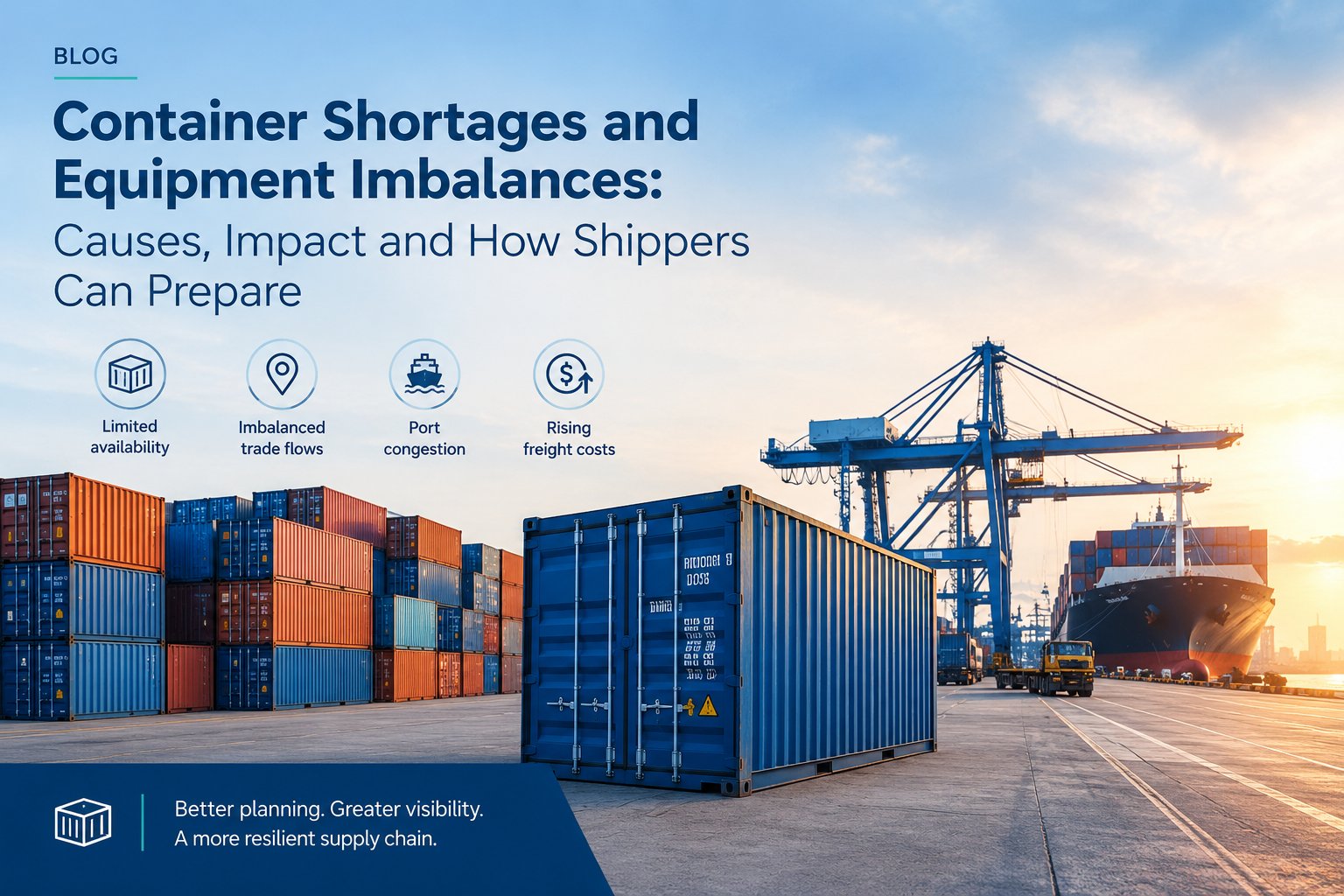
What Are Container Shortages and Equipment Imbalances?
A container shortage occurs when shipping containers are not available at the location where exporters need them. Equipment imbalance is the broader industry problem behind this situation: containers accumulate in some locations while exporters in other locations struggle to find the right equipment.
It may seem straightforward—there are millions of containers operating globally, so why can a shipper still be told that no equipment is available?
The answer lies in where the containers are located, what type they are, and how quickly they can be repositioned.
Global container flows are rarely balanced. Some trade lanes consistently move significantly more cargo in one direction than the other. UN Trade and Development notes that around 20% of containers transported by sea are repositioned empty, illustrating the scale of the industry's equipment-balancing challenge.
Why Do Container Shortages Happen?
Container shortages rarely have one single cause. They usually result from several factors occurring simultaneously.
1. Imbalanced trade flows
Consider a trade lane where significantly more goods move from Asia to Europe than in the opposite direction.
Containers arrive in Europe full, but fewer export shipments are available to send those same containers back to Asia.
The result?
Container surplus at the destination + container shortage at the origin.
Shipping lines then need to reposition empty containers, which costs time and money without generating freight revenue.
2. Port congestion
When vessels wait longer to berth or containers remain at terminals for extended periods, equipment spends more time within the network.
This reduces the number of containers immediately available for new export bookings.
Current shipping conditions demonstrate how quickly this can happen. In August 2026, Maersk reported vessel waiting times of up to 12 days at Shanghai amid strong demand and infrastructure constraints.
3. Geopolitical disruptions
Changes to shipping routes can have an unexpected effect on container availability.
For example, when vessels are rerouted around major maritime chokepoints, containers can remain in transit for longer. UNCTAD has noted that Red Sea-related rerouting increased vessel demand and contributed to supply-demand imbalances in container shipping.
4. Sudden increases in demand
When exporters suddenly increase bookings, available equipment can be absorbed faster than shipping lines can reposition empty containers.
This is particularly relevant during peak seasons or periods when companies bring forward shipments because of tariffs, geopolitical uncertainty or inventory concerns.
5. Equipment type and location
“Container availability” does not simply mean whether a container exists.
A shipper may require:
-
20-foot container
-
40-foot container
-
40-foot high cube
-
Reefer container
-
Special equipment
A port may have plenty of 40-foot containers but insufficient 20-foot equipment.
So, the real question is:
Is the right container available, at the right location, at the right time?
How Do Equipment Imbalances Affect Freight Costs?
Container shortages can put upward pressure on ocean freight rates.
When equipment is scarce, carriers may have limited flexibility to accept additional bookings. At the same time, strong demand can allow freight rates to rise.
But container availability is only one part of the pricing equation.
Freight rates also depend on:
-
Vessel capacity
-
Cargo demand
-
Fuel costs
-
Port congestion
-
Trade lane conditions
-
Canal disruptions
-
Carrier capacity management
-
Seasonal demand
-
Transshipment constraints
UNCTAD describes freight-rate volatility as a continuing feature of the shipping market, driven by geopolitical developments and supply-demand imbalances.
Recent conditions illustrate this relationship. Indian exporters, for example, have faced higher freight costs and container shortages amid congestion at key transshipment hubs in Asia.
The Hidden Cost: Shipping Delays
The impact of an equipment shortage goes beyond the freight quotation.
If an exporter cannot secure equipment, the shipment may miss its planned sailing.
That can create a chain reaction:
No container → missed cut-off → missed vessel → revised sailing → delayed delivery
For businesses operating on tight production or inventory schedules, even a single missed sailing can have wider consequences.
Potential impacts include:
-
Production delays
-
Higher inventory requirements
-
Missed customer commitments
-
Warehouse costs
-
Additional trucking costs
-
Expedited transportation
-
Increased working-capital requirements
This is why container availability should be considered during shipment planning—not only when the cargo is ready to move.
How Can Shippers Manage Container Shortages?
Businesses cannot control global equipment availability, but they can improve how they plan around it.
Check equipment availability early
Do not wait until cargo is ready for pickup to determine whether the required container is available. Work with logistics providers like Vanguard Logistics to plan ahead, assess equipment availability and discuss potential options if constraints arise.
Maintain realistic shipping timelines
When equipment shortages or port congestion are present, avoid planning around the most optimistic transit scenario.
Build reasonable buffers into critical shipments.
Evaluate alternative ports and services
Depending on the trade lane, another port, carrier service or routing option may provide better equipment availability.
Improve shipment visibility
Visibility becomes especially valuable when shipping schedules are changing.
Tracking booking milestones, container allocation, vessel schedules and estimated arrival dates can help logistics teams identify potential problems earlier.
Review container requirements
For some shipments, changing equipment type or shipment configuration may provide additional flexibility—but this should always be evaluated against cargo requirements and cost.
What Does Container Availability Mean for FCL Shippers?
For Full Container Load (FCL) shipments, equipment availability is directly linked to the ability to execute a booking.
An FCL shipment uses an entire container exclusively for one shipper's cargo.
Therefore, securing the right equipment at the origin is a critical part of the shipping process.
Vanguard's FCL Ocean Freight services provide an example of how shippers can approach FCL planning by combining route and schedule information with rate requests and booking management.
The broader lesson is that freight planning should consider both transportation capacity and physical equipment availability.
Looking Ahead: Will Container Shortages Continue?
Container shortages are unlikely to disappear completely because the underlying issue—imbalanced global trade flows—is structural.
However, the severity of shortages can change quickly.
A combination of strong demand, port congestion, geopolitical disruption and longer shipping routes can tighten equipment availability, while weaker demand and improved container repositioning can ease pressure.
The experience of recent years has therefore highlighted an important shift in supply-chain planning:
Container availability should be treated as a dynamic operational variable, not a guaranteed resource.
For shippers, better planning means looking beyond the freight rate and asking a more practical question:
Can the right equipment be secured at the right place and time to meet the required delivery schedule?
That question can make the difference between a shipment that moves as planned and one that misses its sailing before it has even left the warehouse.