 Back to News & Articles

When comparing freight quotes, it is tempting to choose the lowest number on the page. After all, if one provider quotes $1,000 and another quotes $1,200 for the same shipment, why pay more?
But international shipping is rarely that simple.
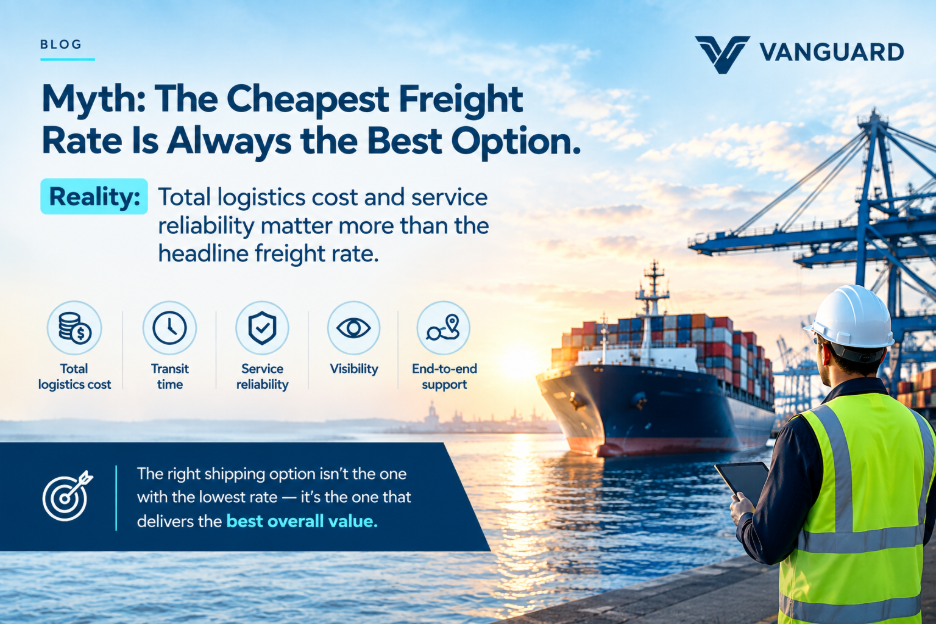
The lowest ocean freight rate does not always translate into the lowest total logistics cost. A cheaper rate can come with longer transit times, less frequent sailings, additional handling, limited visibility, or a higher risk of delays. Once those factors are considered, the initial saving may disappear—or even turn into a higher overall cost.
For businesses managing international supply chains, the better question is not “Who offers the cheapest freight rate?”
It is:
“Which shipping option delivers the right balance of cost, reliability, transit time and service for my business?”
What Does a Freight Rate Actually Tell You?
A freight rate generally represents the cost of moving cargo between specified points. However, it may not capture every expense associated with getting that cargo from the supplier to its final destination.
Depending on the shipment, the overall logistics cost can include:
-
Ocean freight
-
Origin handling and CFS charges
-
Documentation fees
-
Customs-related costs
-
Inland transportation
-
Destination handling
-
Storage
-
Demurrage or detention
-
Cargo insurance
-
Additional surcharges
-
Costs associated with delays or missed connections
This is why comparing freight rates alone can provide an incomplete picture.
A shipment with a slightly higher ocean rate may ultimately be more economical if it offers a more suitable schedule, fewer handling points, and better predictability.
The Hidden Cost of a Cheap Freight Rate
Imagine two shipping options for the same cargo.
Option A: Lower freight rate, but longer transit and fewer sailing options.
Option B: Slightly higher freight rate, but better schedule frequency and a more reliable transit time.
At first glance, Option A looks cheaper.
But what happens if the longer transit causes the shipment to arrive after the customer's required delivery date?
The business may then face:
Missed delivery → production disruption → additional storage → expedited transportation → higher total cost
The original freight saving can quickly disappear.
This is particularly important for businesses shipping time-sensitive products, components or inventory that supports production schedules.
Transit Time Is a Cost Too
Time has a financial value in logistics.
A longer transit time can mean inventory remains in transit for longer, tying up working capital and potentially requiring businesses to hold additional safety stock.
For example, if a shipment normally takes 25 days but an alternative service takes 40 days, the lower freight rate may not be beneficial if the additional 15 days affect inventory planning or customer commitments.
This is why shippers should evaluate freight cost and transit time together.
When comparing options, ask:
-
What is the transit time?
-
How frequently does the service operate?
-
How many transshipments are involved?
-
How reliable is the schedule?
-
What happens if the shipment is delayed?
-
Does the service align with the required delivery date?
Reliability Can Be More Valuable Than a Lower Rate
A predictable shipment can be easier to manage than a cheaper but uncertain one.
For businesses, service reliability can influence:
-
Production planning
-
Inventory levels
-
Warehouse utilisation
-
Customer commitments
-
Cash flow
-
Sales planning
-
Overall supply-chain performance
This does not mean that the most expensive service is automatically the best.
Instead, businesses should identify the level of reliability their shipment actually requires.
A non-urgent shipment may be perfectly suited to a lower-cost service with a longer transit time.
A time-sensitive shipment may justify paying more for a faster or more frequent service.
The right choice depends on the business need—not simply the freight rate.
LCL vs. FCL: Cost Is Not the Only Consideration
The same principle applies when deciding between LCL (Less than Container Load) and FCL (Full Container Load).
LCL allows businesses to share container space and can be a cost-effective option for smaller shipments. FCL provides dedicated container space and may be more suitable for higher-volume or time-sensitive cargo.
The right choice depends on factors such as:
-
Cargo volume
-
Shipment frequency
-
Transit requirements
-
Handling requirements
-
Delivery timelines
-
Total logistics cost
Vanguard's LCL shipping services highlight LCL as an option for smaller shipments where businesses want flexibility and cost efficiency, while its FCL shipping services focus on dedicated container space, control and predictable shipping requirements.
The key is to choose the solution based on what the shipment requires, rather than assuming the lowest quoted rate is automatically the most economical option.
Don't Forget the Inland Leg
Another common mistake is focusing on the ocean freight component while overlooking what happens before and after the port.
A low ocean rate can be less attractive if the shipment requires expensive or unreliable inland transportation.
Consider the complete journey:
Supplier → Pickup → CFS/Warehouse → Port → Ocean → Destination Port → Inland Transportation → Final Delivery
Each stage can influence the final cost and delivery timeline.
An integrated approach can help businesses evaluate the shipment as a complete movement rather than a collection of disconnected services.
Vanguard's inland transportation solutions connect port, warehouse and final-delivery movements with ocean and air freight services, helping businesses consider transportation beyond the main ocean leg.
Visibility Can Reduce the Cost of Uncertainty
Another factor that is often overlooked when comparing freight options is shipment visibility.
Knowing where cargo is and whether the expected delivery date has changed allows logistics teams to respond earlier.
For example:
No visibility:
Shipment delayed → business discovers the problem late → limited options → potential additional cost.
Better visibility:
Shipment delayed → team identifies the exception earlier → alternative arrangements can be evaluated → disruption may be reduced.
Vanguard provides shipment tracking and digital visibility across its logistics network, including milestone and shipment-status information.
Visibility does not eliminate delays. But it can give businesses more time to understand, communicate and respond to them.
How Should You Compare Freight Quotes?
Instead of creating a simple table of freight rates, consider evaluating each option across several factors.
A practical freight comparison checklist:
1. Total cost
What will the shipment cost from origin to destination?
2. Transit time
Does the service meet your delivery requirements?
3. Schedule frequency
How many sailing options are available?
4. Reliability
How consistently does the service operate according to schedule?
5. Routing
Are there direct services or multiple transshipments?
6. Handling requirements
How many times will the cargo be handled?
7. Visibility
Can you track the shipment and receive timely updates?
8. Flexibility
What options are available if the original plan changes?
9. Inland connectivity
How efficiently can the cargo move beyond the port?
10. Business impact
What happens if the shipment arrives late?
This approach shifts the conversation from “Who has the cheapest rate?” to “Which option provides the best overall value?”
When Does the Cheapest Option Make Sense?
The cheapest freight rate isn't always a bad choice.
If a shipment is:
-
Non-urgent
-
Flexible on delivery date
-
Low-risk
-
Not tied to production
-
Not sensitive to inventory carrying costs
then a lower-cost, slower service may be exactly what the business needs.
The important thing is to make that decision deliberately, rather than assuming that the lowest rate is always the most economical.
The Better Way to Think About Freight Costs
The true cost of shipping goes beyond the amount shown on a freight quote.
Freight rate ≠ total logistics cost.
A more complete calculation considers:
Freight + Handling + Inland Transportation + Storage + Inventory Cost + Delay Risk + Service Reliability
This is particularly important in a market where geopolitical disruptions, port congestion, equipment availability and changing trade routes can quickly affect shipping schedules and costs.
For businesses, the objective should not always be to minimise freight cost.
It should be to optimise the total logistics outcome.
The Bottom Line
The cheapest freight rate can be attractive—but it should never be the only factor guiding a shipping decision.
A slightly higher rate may deliver better schedule frequency, stronger reliability, fewer disruptions and greater visibility. In the right circumstances, those benefits can save more money than the initial freight-rate difference.
At Vanguard, we focus on delivering the right solution for your business based on factors such as volume, timing, budget, and supply chain priorities. Because in logistics, the best option is the one that delivers the greatest overall value across your supply chain.