 Back to News & Articles

An ocean shipment may appear simple from the outside: cargo leaves the supplier, travels by vessel and arrives at the destination. An international ocean shipment passes through multiple stages involving exporters, importers, carriers, ports, warehouses, customs authorities, trucking providers and logistics partners.
Each stage has its own documentation, deadlines, and operational requirements. A delay at one point can affect everything that follows. This is why understanding the complete journey of an ocean shipment is important—not only for logistics professionals, but also for businesses planning inventory, production and customer deliveries.
Ocean shipping continues to be the backbone of international trade. UN Trade and Development (UNCTAD) estimates that maritime transport carries more than 80% of the volume of international trade in goods. At the same time, changing trade routes, port congestion, geopolitical disruptions and freight-rate volatility are making shipment planning increasingly complex.
So, what actually happens after a shipment is booked?
1. It Starts with a Shipping Requirement
Before a booking is made, the shipper needs to establish what is being moved, where it is going, and when it needs to arrive.
The shipment details typically include the origin and destination, cargo description, number of packages, weight and volume, required equipment, shipment readiness date and preferred service. The choice between LCL (Less than Container Load) and FCL (Full Container Load) is also an important consideration.
With FCL, an entire container is used exclusively for one shipment. With LCL, cargo from different shippers is consolidated into a container. The appropriate option depends on factors such as cargo volume, timing, budget and handling requirements.
For businesses shipping smaller volumes, for example, LCL can provide an alternative to waiting until enough cargo is available to fill an entire container. Vanguard Logistics's LCL shipping services provide information on consolidation, booking and shipment visibility, while its FCL shipping services cover full-container requirements.
2. Quoting, Schedule Selection and Booking
Once the shipment requirements are known, the next step is selecting an appropriate ocean service.
A freight quote is more than just a price. Shippers also need to consider sailing frequency, estimated transit time, routing, transshipment requirements, cut-off dates and the expected arrival date.
This is particularly important when schedules are changing because of port congestion, equipment constraints or disruptions to major shipping routes. UNCTAD's latest maritime transport analysis highlights how geopolitical tensions and reconfigured shipping routes can affect shipping distances, costs and reliability.
After the service is selected, the shipment is booked. A booking confirmation generally provides key information such as the vessel or voyage, port of loading, port of discharge, sailing date and applicable cut-off deadlines.
For example, Vanguard's FCL booking processenables customers to search routes, compare schedules, request rates and book shipments.
For LCL shipments, Vanguard's digital platform also allows customers to quote and book shipments online and manage them through the shipment lifecycle.
3. Documentation and Shipping Instructions
A booking is only one part of getting cargo ready for the vessel.
The shipper must provide the required shipment and cargo information so that the necessary documentation can be prepared. Depending on the shipment, this can include commercial invoices, packing lists, shipping instructions, certificates and customs-related information.
Accuracy matters at this stage. Incorrect cargo descriptions, weights, dimensions, consignee details or documentation can result in delays or additional work later in the process.
Documentation requirements can be particularly important when shipping hazardous or dangerous goods. Such cargo may require specific classification, documentation, packaging, marking and labelling requirements before it can be accepted for ocean transport. Under the International Maritime Dangerous Goods (IMDG) Code, dangerous goods must be appropriately described, marked, labelled, placarded and documented. The information provided to the carrier must also accompany the shipment through to its final destination.
For this reason, shippers should identify hazardous goods early in the booking process and provide accurate information about the cargo. Proper labelling and documentation help carriers and other parties involved in the shipment identify the goods and apply the appropriate handling, stowage and transport requirements. The current IMDG Code requirements have been mandatory since 1 January 2026.
For containerised ocean cargo, documentation deadlines also matter. Documentation cut-offs and cargo cut-offs are linked to the planned sailing, so missing a required deadline can potentially result in the shipment being rolled to a later sailing.
Vanguard provides digital tools for managing shipment information and documentation, while its tracking capabilities can provide visibility into important shipment milestones, including vessel and voyage details, container information and relevant cut-off information.
4. Cargo Moves From the Supplier
Once the booking is confirmed and the cargo is ready, the physical movement begins.
For an FCL shipment, the empty container needs to be made available, collected and transported to the shipper's premises. The cargo is then loaded and secured inside the container before the container moves towards the port or designated facility.
For LCL shipments, cargo may first move to a Container Freight Station (CFS) or warehouse, where shipments from different customers are received, consolidated and prepared for the main ocean movement.
This is an important distinction between the two shipping models. An FCL shipment generally involves a dedicated container, while LCL cargo passes through a consolidation process before being loaded into the container.
5. CFS and Warehouse Handling
For LCL shipments, the CFS plays an important role in the shipment journey.
Cargo arriving at the CFS is received, checked and prepared for consolidation. Shipments moving to the same destination or through the same service may be grouped together into a container.
This stage involves coordination between warehouse teams, transport providers, documentation teams and the ocean service.
For businesses, it is important to understand that port-to-port transit is only one part of the total shipment timeline. Cargo may spend time moving between the supplier, CFS, port and destination facilities before reaching its final delivery point.
Vanguard operates CFS and warehouse facilities as part of its global logistics network, supporting cargo storage, consolidation and handling.
6. The Shipment Reaches the Port
Once the cargo or container reaches the origin port, it enters another important stage of the journey.
The shipment must meet the relevant terminal and carrier requirements before it can be loaded onto the vessel. The timing of the arrival matters because ports operate according to vessel schedules and cargo cut-off times.
Missing a cut-off can mean the cargo does not make the intended sailing.
Ports also have their own operational challenges. Congestion, vessel bunching, weather conditions, labour issues, equipment availability and changes in vessel schedules can affect how quickly cargo moves through a terminal.
UNCTAD's 2025 review noted rising congestion and handling times at ports in 2024, highlighting how port performance can influence the wider maritime supply chain.
7. Loading and the Ocean Journey
Once the container has cleared the necessary origin processes, it is loaded onto the vessel.
This is the stage most people associate with ocean freight, but it represents only one part of the complete shipment journey.
The vessel then follows its planned route to the destination. Depending on the service, the shipment may travel directly or pass through one or more transshipment hubs, where the container is transferred from one vessel to another.
During the ocean journey, schedules can change. Weather, port congestion, equipment issues, geopolitical developments and changes in vessel routing can all influence the estimated arrival date.
This is why shipment visibility becomes particularly useful after cargo has departed. Rather than relying only on the original ETA, logistics teams can monitor actual milestones and respond when the schedule changes.
8. Tracking the Shipment While It Is in Transit
For the shipper, the journey does not disappear once the vessel sails.
Tracking provides information about where the shipment is and how it is progressing against the original plan.
Depending on the service and tracking system, important milestones can include vessel departure, transshipment, estimated arrival, actual arrival, discharge and cargo availability.
Vanguard's shipment tracking capabilities provide shipment-status information and milestone visibility, while its Quick Track service allows users to access shipment information using a booking reference.
This visibility can be particularly useful when a shipment is delayed. Early awareness gives businesses more time to communicate with customers, adjust inventory plans or consider alternative arrangements.
9. Arrival at the Destination Port
When the vessel reaches the destination port, the shipment is discharged.
For LCL cargo, the container may then move to a destination CFS where it is deconsolidated. Individual shipments are separated from the consolidated container and prepared for their next stage.
For FCL cargo, the container typically remains intact as it moves through the destination process.
At this stage, the shipment may also be subject to customs clearance and other regulatory requirements before it can be released.
10. Customs Clearance and Cargo Release
Customs clearance is another critical part of the journey.
The required documentation and information are reviewed by the relevant authorities, and duties, taxes or other regulatory requirements may need to be addressed depending on the shipment and destination.
Delays can occur if documentation is incomplete, information is inaccurate or additional checks are required.
This makes customs planning important well before the vessel arrives. Vanguard's customs services integrate customs support with LCL and FCL shipping, inland transportation and warehousing, with digital capabilities for tracking documentation and clearance status.
11. From Destination Port to Final Delivery
Once the shipment has been cleared and released, it still has one more major journey to complete.
The cargo needs to move from the destination port or CFS to its final location. Depending on the shipment, this can involve trucking, rail, intermodal transportation or other inland solutions.
This final stage is particularly important when the shipment is being delivered directly to a warehouse, distribution centre, factory or customer.
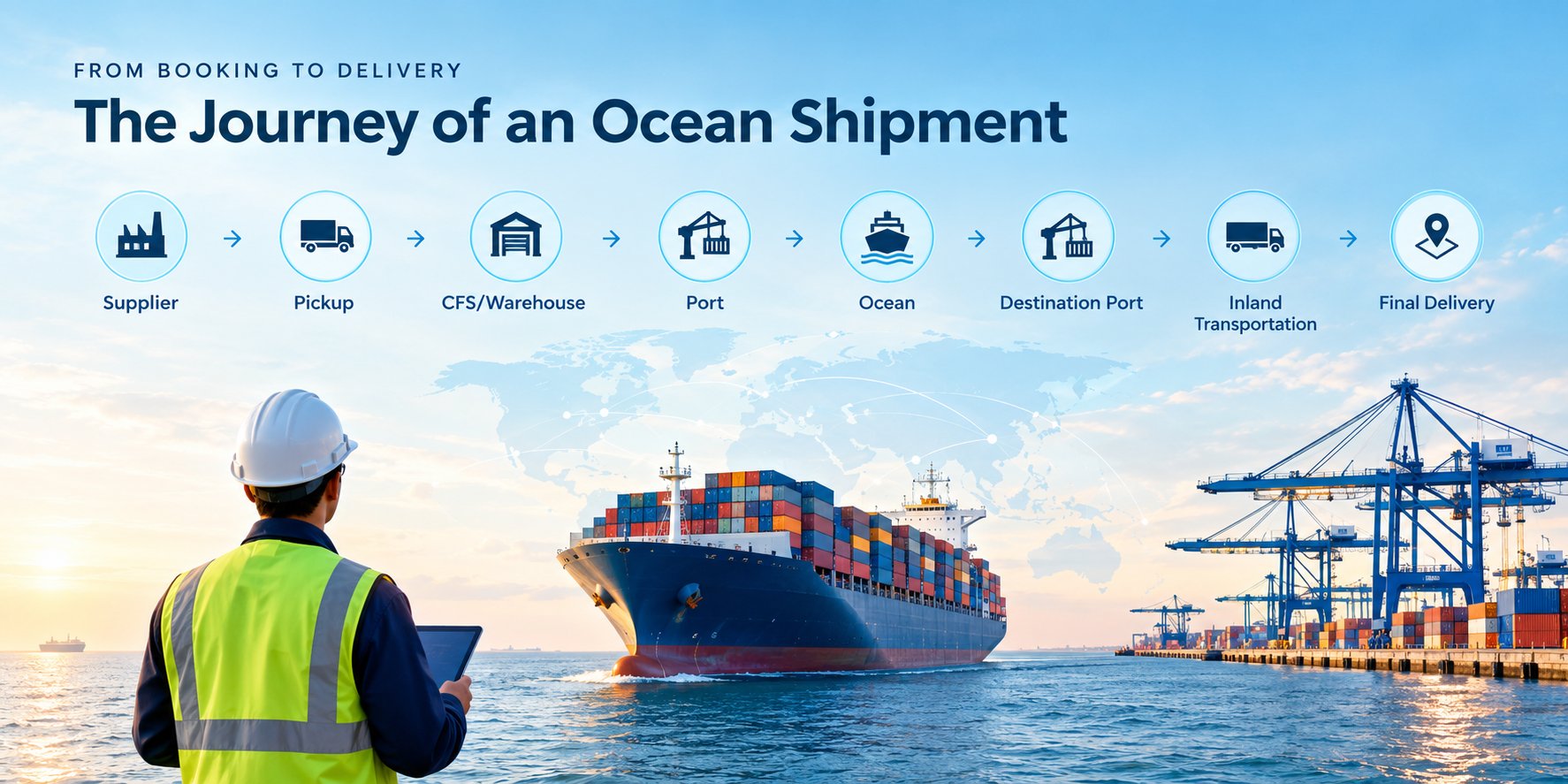
The complete journey can therefore be represented as:
Supplier → Pickup → CFS/Warehouse → Port → Ocean → Destination Port → Inland Transportation → Final Delivery
Looking only at the ocean leg can make a shipment appear simpler than it actually is. A vessel may arrive on time, but the cargo can still experience delays during customs clearance, CFS handling, inland transportation or final delivery.
Vanguard's inland solutions cover transportation from collection through final mile, supporting the movement of cargo beyond the main ocean leg.
From Booking to Delivery: One Connected Journey
An ocean shipment does not begin when the vessel leaves the port, and it does not end when the vessel arrives.
It begins with understanding the cargo requirement and selecting an appropriate service. It continues through booking, documentation, pickup, CFS or warehouse handling, port operations, vessel movement, destination processing, customs clearance, inland transportation and final delivery.
Every stage contributes to the final outcome.
For shippers, understanding this complete journey can make it easier to plan realistic delivery timelines, identify potential risks and communicate more effectively when conditions change.
The objective is not simply to move cargo from one port to another. It is to manage the entire journey from origin to destination with the right combination of cost, timing, visibility and operational coordination.
As global shipping continues to face changing trade routes, port pressures and greater operational uncertainty, that end-to-end perspective is becoming increasingly important. Resilient, connected, and digitally enabled supply chains are the key to effectively managing ocean shipments from origin to destination.