 Back to News & Articles

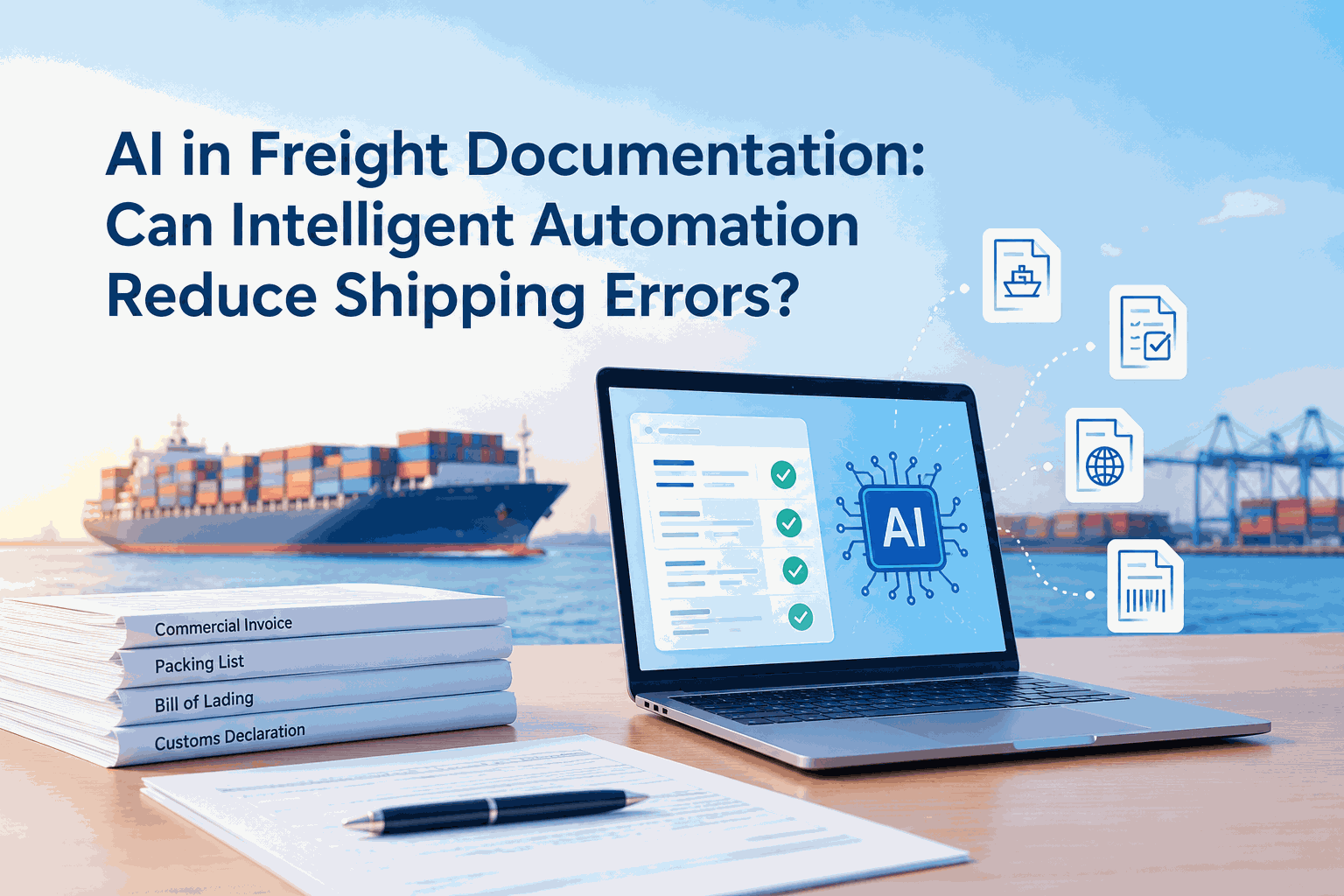
International freight shipments involve more than moving cargo from one location to another. Each shipment requires information to be collected, checked, exchanged, and recorded across multiple documents and systems. Commercial invoices, packing lists, bills of lading, shipping instructions, certificates and customs declarations all play a role in the shipping process, depending on the shipment and applicable requirements.
Even a small discrepancy in cargo descriptions, weights, quantities, addresses or shipment references can lead to additional checks, document amendments, and delays. When the same information is entered manually into different systems, the risk of inconsistent or incomplete data increases.
This is where artificial intelligence (AI) and intelligent automation are gaining attention. By helping logistics teams extract information from documents, compare data across records and flag potential inconsistencies, these technologies can reduce repetitive manual work and make document checks more efficient.
However, can AI eliminate shipping documentation errors, or is its greatest value in helping people identify and resolve them earlier? The answer depends on the quality of the source data, the technology being used, and the level of human oversight built into the process.
Why Is Freight Documentation Still Prone to Errors?
Freight documentation involves information from multiple parties, including exporters, importers, carriers, customs authorities, warehouses, and logistics providers. Each party may create, review, or use different documents throughout the shipment journey.
Errors can occur for several reasons.
Repeated data entry: Shipment details may need to be entered into multiple systems or documents. Re-entering the same information creates opportunities for spelling mistakes, incorrect figures, and inconsistent records.
Inconsistent information across documents: The cargo description, package count, gross weight or shipper, and consignee details may differ between the commercial invoice, packing list and shipping instructions.
Incomplete documentation: Required information may be missing, or a document may not meet the requirements of the relevant carrier, destination or regulatory authority.
Changing shipment details: Booking information can change after the initial documents are prepared. If those changes are not reflected in every relevant record, discrepancies may arise.
Complex cargo requirements: Certain shipments, including hazardous goods, may require specific declarations, classifications, marks, labels, and supporting documents. Errors or omissions can result in additional checks and handling restrictions.
These challenges are not simply a consequence of paperwork. They also reflect the difficulty of keeping information accurate and consistent across different parties, processes, and systems. The Digital Container Shipping Association (DCSA) identifies inconsistent data formats and manual document handling as contributors to discrepancies, operational delays and additional costs in container shipping.
How Can AI Help Reduce Shipping Documentation Errors?
AI can support documentation teams by processing information, identifying patterns and highlighting discrepancies that may otherwise require time-consuming manual checks. Its effectiveness depends on the quality of the data, the type of document and how the system is integrated into existing workflows.
1. Extracting Information from Shipping Documents
AI-enabled document processing tools can use optical character recognition (OCR) and language-processing techniques to extract information from invoices, packing lists, booking confirmations, and other shipping documents.
For example, a system may identify the shipper's name, consignee details, cargo description, package count, weight, and shipment reference from a commercial invoice.
Instead of manually typing every field into another system, a documentation team can review the extracted information and confirm that it has been captured correctly.
This can reduce repetitive data entry and help teams process larger volumes of documents more efficiently. However, scanned documents with poor image quality, handwritten information, or unfamiliar layouts may still require manual correction.
2. Comparing Data Across Multiple Documents
One of the most useful applications for intelligent automation is checking whether information matches related documents.
Consider a shipment where the packing list states a gross weight of 8,500 kg, but the shipping instructions contain 8,050 kg. A rule-based validation system or AI-assisted tool could flag the discrepancy for review before the documents are finalised.
Similar checks can be applied to:
- Shipper and consignee names
- Cargo descriptions
- Package counts and quantities
- Gross weight and dimensions
- Booking and container references
- Ports of loading and discharge
These checks can help teams identify inconsistencies earlier in the process, reducing the likelihood of errors being carried forward into subsequent documentation.
Not every difference is necessarily an error. Some documents may legitimately contain different information because they serve different purposes. Automated checks should therefore apply appropriate rules rather than treating every variation as a discrepancy.
3. Identifying Missing Information
An AI-assisted system can review a document against a checklist and flag fields that appear to be missing or incomplete.
For example, it might identify a missing shipment reference, an incomplete consignee address, or an absent cargo description before the document moves to the next stage.
For specialised cargo, the system could also prompt the documentation team to check whether the relevant declarations or supporting documents have been provided.
These checks can improve the completeness of documentation, but they should not be treated as confirmation that a shipment meets every applicable legal or regulatory requirement. Final validation must account for the cargo type, trade lane, carrier requirements, and regulations in force.
4. Supporting Shipping Instructions and Bill of Lading Preparation
Shipping instructions provide information used by the carrier to prepare the bill of lading. If the submitted details are inaccurate, the draft transport document may require amendments before it can be finalised.
Intelligent automation can help compare submitted shipping instructions against booking information, identify missing fields, and highlight differences for review.
Digital standards can strengthen this process further. The DCSA's Booking and Bill of Lading standards are designed to support the exchange of structured data and reduce discrepancies associated with manual intervention.
AI and standardised digital data serve complementary purposes: AI can help interpret and check information, while standardised data exchange can reduce the need to enter the same information repeatedly.
5. Flagging Potential Compliance Issues
International shipments may be subject to different documentation requirements depending on the goods, origin, destination, and mode of transport.
AI-assisted systems can be configured to flag potential issues, such as missing fields, inconsistent commodity descriptions or absent supporting documents. They can also help teams locate relevant information within large sets of records.
For hazardous goods, however, automated checks must be particularly carefully designed. Correct classification, declarations, packaging, marking and labelling depend on the applicable dangerous-goods rules. A system flag is a prompt review, not a substitute for the required expertise or formal compliance checks.
6. Managing Document Revisions
Shipment details may change after booking because of updated cargo information, schedule changes, or corrections requested by a carrier or another party.
Document-management tools can help maintain version of histories, record amendments and make revised documents available to the appropriate teams. AI may assist by identifying differences between versions and summarising what has changed.
This can help teams determine whether an amendment affects other documents or records. It is particularly useful when several parties are working with different versions of the same shipment information.
AI vs Traditional Freight Documentation: What Is the Difference?
AI is not the only way to reduce shipping documentation errors. Rule-based automation, standardised digital documents, and integrated systems can also improve accuracy. The main difference lies in how these approaches handle information.
|
Approach |
What it does |
Potential benefit |
|
Manual processing |
Staff enter, compare and review documents |
Human judgement for complex cases |
|
Rule-based automation |
Checks predefined fields, formats and conditions |
Consistent validation of known requirements |
|
AI-assisted processing |
Extracts information and identifies potential inconsistencies |
Helps process varied documents and prioritise reviews |
|
Integrated digital systems |
Exchange structured data between connected systems |
Reduces repeated entry and discrepancies between records |
The most effective approach may combine these methods rather than relying on AI alone.
For example, a system could use OCR to extract shipment details, predefined rules to validate mandatory fields, AI to flag unusual discrepancies, and a documentation specialist to review the results before submission.
This combination can help teams work more efficiently while keeping important decisions under human oversight.
What Are the Limitations of AI in Freight Documentation?
Although AI offers practical benefits, it is not a guarantee of error-free shipping documentation.
Incorrect source information: If the shipper provides inaccurate cargo details, AI may process that information correctly without recognising that the original data is wrong.
Misinterpretation of documents: Poor-quality scans, unusual formats, abbreviations and handwritten entries can lead to incorrect extraction.
Different regulatory requirements: Documentation requirements vary by cargo type, trade lane, destination and applicable regulations. Systems need accurate, current rules and appropriate configuration.
False alerts: Automated tools may flag legitimate differences or fail to identify an error that falls outside their validation rules.
Data security and confidentiality: Commercial invoices, customer details and shipment records may contain sensitive business information. Organisations must consider access controls, data protection and how information is processed by third-party AI systems.
Human oversight: AI-generated results need appropriate verification, especially for customs declarations, dangerous goods and documents with legal or financial implications.
The goal should therefore be to reduce avoidable errors and make reviews more effective—not to remove human responsibility from the documentation process.
The Role of Digital Standards in Freight Documentation
AI can help interpret and validate information, but reliable digital data exchange is equally important.
The Digital Container Shipping Association develops standards intended to make container shipping processes more consistent and interoperable. Its electronic bill of lading initiative aims to reduce paper handling and support the digital exchange of transport documents.
Similarly, the International Chamber of Commerce's Digital Standards Initiative works to improve the standardisation and digitalisation of trade documents and data.
These initiatives address a key challenge in international logistics: different organisations often use different systems and formats to exchange information.
When shipment data can move between systems in a consistent, structured format, there is less need to re-enter the same information manually. AI can then build on that foundation by helping teams interpret documents, identify exceptions and review inconsistencies.
For logistics businesses, the opportunity lies in combining accurate data, interoperable systems, intelligent automation and human expertise.
How Can Logistics Teams Prepare for AI-Enabled Documentation?
Adopting AI does not necessarily require replacing existing documentation systems all at once. Businesses can begin by identifying repetitive tasks and common sources of error.
A practical starting point is to review where documentation teams spend the most time correcting data, comparing documents or following up on missing information.
From there, organisations can:
-
Identify recurring errors: Review document amendments, rejected submissions and common data discrepancies.
-
Start with repetitive tasks: Test automation for data extraction, mandatory-field checks and comparisons between related documents.
-
Establish clear validation rules: Define which fields must match and which differences require further investigation.
-
Integrate systems carefully: Reduce duplicate data entry by connecting relevant booking, documentation and shipment-management systems.
-
Retain human review: Set clear approval requirements for high-risk or regulated shipments.
-
Measure results: Track error rates, amendment frequency, document processing time and the number of issues detected before submission.
Starting with a clearly defined workflow makes it easier to assess whether automation is delivering meaningful improvements before expanding its use.
What Does This Mean for the Future of Freight Documentation?
AI is creating opportunities to make freight documentation more efficient, but its value extends beyond faster data entry. When combined with digital document standards and connected logistics systems, it can help teams identify discrepancies earlier, reduce repetitive checks and manage document changes more consistently.
For global shipping, even small improvements in documentation quality can matter. An error caught before submission may be easier to resolve than one discovered after a document has been issued or a shipment has reached a customs checkpoint.
The future of freight documentation is therefore unlikely to depend on AI alone. It will involve a combination of standardised data, automated validation, digital document exchange and experienced professionals who can assess exceptions and make informed decisions.
For logistics teams, the priority is to identify where errors occur most frequently and determine which tasks can be automated safely. The real opportunity is not simply to process documents faster, but to make shipping information more accurate, consistent and easier to manage across the shipment journey.